This is a free and fast online utility that extracts a visual color palette from a BMP image. You can use the configuration options (below) to group similar tones or keep exact pixel colors, choose the number of swatches, and set the order in which they appear. Extra options allow you to display a hexadecimal or RGB code on each swatch, show the percentage of the image that uses each extracted color, and copy all palette codes as text. Created by graphics designers from team Browserling.
This is a free and fast online utility that extracts a visual color palette from a BMP image. You can use the configuration options (below) to group similar tones or keep exact pixel colors, choose the number of swatches, and set the order in which they appear. Extra options allow you to display a hexadecimal or RGB code on each swatch, show the percentage of the image that uses each extracted color, and copy all palette codes as text. Created by graphics designers from team Browserling.
This free online browser-based program finds the colors used in a BMP image and creates a clear palette from them. Instead of picking colors from the bitmap by eye, you can let the program count them and display the selected tones as stacked swatches in a separate image. You can extract colors in two ways. The average-colors mode gathers nearby shades into color families, which gives you a compact overview of the bitmap's visual character even when the image contains gradients, antialiasing, or photographic detail. The exact-colors mode keeps pixel values separate and reports the individual colors that occur most often, which is useful for inspecting icons, sprites, diagrams, and other artwork with a controlled set of tones. You can enter any palette length you need and arrange the result by pixel frequency, rainbow sequence, reverse rainbow sequence, rising lightness, or falling lightness. For identification, each swatch can stay clean or display its hexadecimal or RGB code. The percentage option shows how much of the image uses each extracted color, so you can quickly see which colors are common and which appear only a little. A text version of the finished palette is also placed in the options area so the codes can be copied directly into a stylesheet or drawing program. The generated palette can also be saved as a separate image. Bmp-abulous!
This free online browser-based program finds the colors used in a BMP image and creates a clear palette from them. Instead of picking colors from the bitmap by eye, you can let the program count them and display the selected tones as stacked swatches in a separate image. You can extract colors in two ways. The average-colors mode gathers nearby shades into color families, which gives you a compact overview of the bitmap's visual character even when the image contains gradients, antialiasing, or photographic detail. The exact-colors mode keeps pixel values separate and reports the individual colors that occur most often, which is useful for inspecting icons, sprites, diagrams, and other artwork with a controlled set of tones. You can enter any palette length you need and arrange the result by pixel frequency, rainbow sequence, reverse rainbow sequence, rising lightness, or falling lightness. For identification, each swatch can stay clean or display its hexadecimal or RGB code. The percentage option shows how much of the image uses each extracted color, so you can quickly see which colors are common and which appear only a little. A text version of the finished palette is also placed in the options area so the codes can be copied directly into a stylesheet or drawing program. The generated palette can also be saved as a separate image. Bmp-abulous!
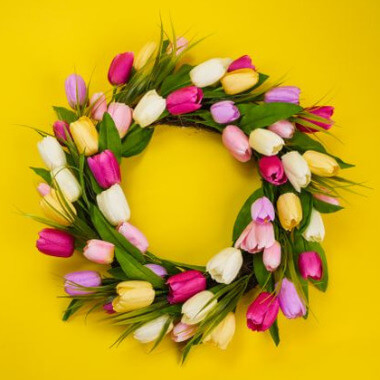
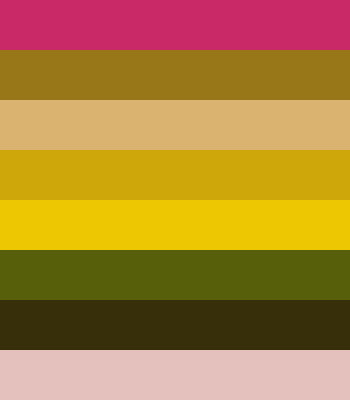
In this example, we load a BMP image of a colorful tulip wreath on a bright yellow background and extract eight average color tones. The tool groups similar shades from the flowers, leaves, and background, and arranges the pink, yellow, brown, and green swatches in rainbow order. (Source: Pexels.)
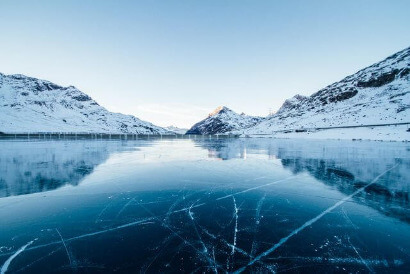
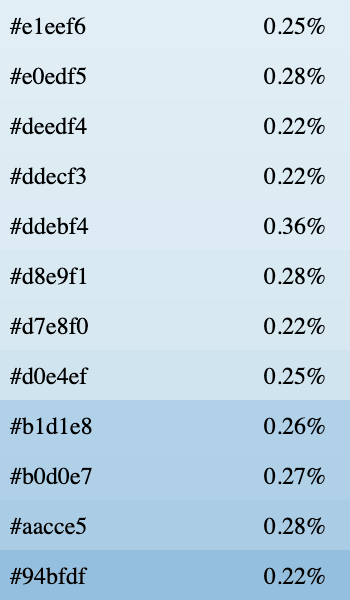
In this example, we find twelve exact pixel colors in a BMP photo of an icy lake and arrange them from lightest to darkest. The most common exact color is #ddebf4, yet it appears in just 0.36% of the pixels. Such small percentages show that the photo contains many distinct tones and smooth color transitions across the sky, snow, and ice. Each swatch includes its hex code and usage percentage. (Source: Pexels.)
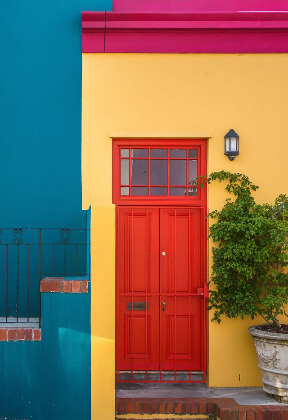
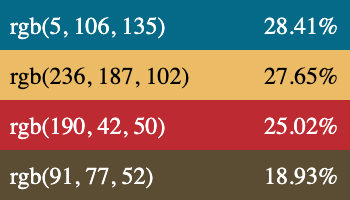
In this example, we create a compact four-color palette from a BMP photo of a bright building facade. The turquoise wall, sandy yellow facade, and red door occupy similar portions of the image at about 28%, 27%, and 25%, respectively. Dark brown details appear a little less often at nearly 19%. The palette makes this balance easy to compare by printing each RGB value beside its percentage. (Source: Pexels.)
Create and edit bitmaps in your browser.
Make a bitmap smaller in size.
Convert a compressed bitmap to a raw RGB pixel bitmap.
Create a swirl of any radius in a bitmap.
Join two or more bitmaps together.
Place two or more bitmaps on top of each other.
Split a bitmap into multiple independent bitmaps.
Extract one or more selected areas from a bitmap.
Make copies of bitmaps and paste them together.
Skew a bitmap by an arbitrary angle.
Shift a bitmap to the left or right.
Convert a BMP to a Webp.
Convert a Webp to a BMP.
Convert a BMP to a PNG.
Convert a PNG to a BMP
Convert a BMP to a JPG.
Convert a JPG to a BMP.
Convert a BMP to a BPG.
Convert a BPG to a BMP.
Save GIF frames as BMP images.
Convert a bitmap to a single-frame GIF.
Create a Data URL scheme of a bitmap.
Convert a Data URL scheme back to a bitmap image.
Bit Blit two or more BMPs.
Put a new color table in a BMP.
Extract the color table of a BMP.
Extract raw RGB pixels from a BMP and print them out as text.
Create a bitmap image from raw RGB pixels.
Randomly rearrange colors in the BMP color table.
Reduce a BMP's memory footprint.
Destroy parts of a bitmap and make it glitchy.
Subscribe to our updates. We'll let you know when we release new tools and features, and when we organize online workshops.
Enter your email here
We're Browserling — a friendly and fun cross-browser testing company powered by alien technology. At Browserling, we love to make people's lives easier, so we created this collection of online bitmap tools. Our BMP tools have the simplest possible user interface and work directly in your browser without downloads or installations. You can use them to edit bitmap images, change BMP bit depth and colors, resize bitmaps, create transparent BMPs, work with bitmap pixels and byte arrays, and much more. Behind the scenes, our bitmap tools are powered by our web developer tools that we've created over the years. Check them out!